
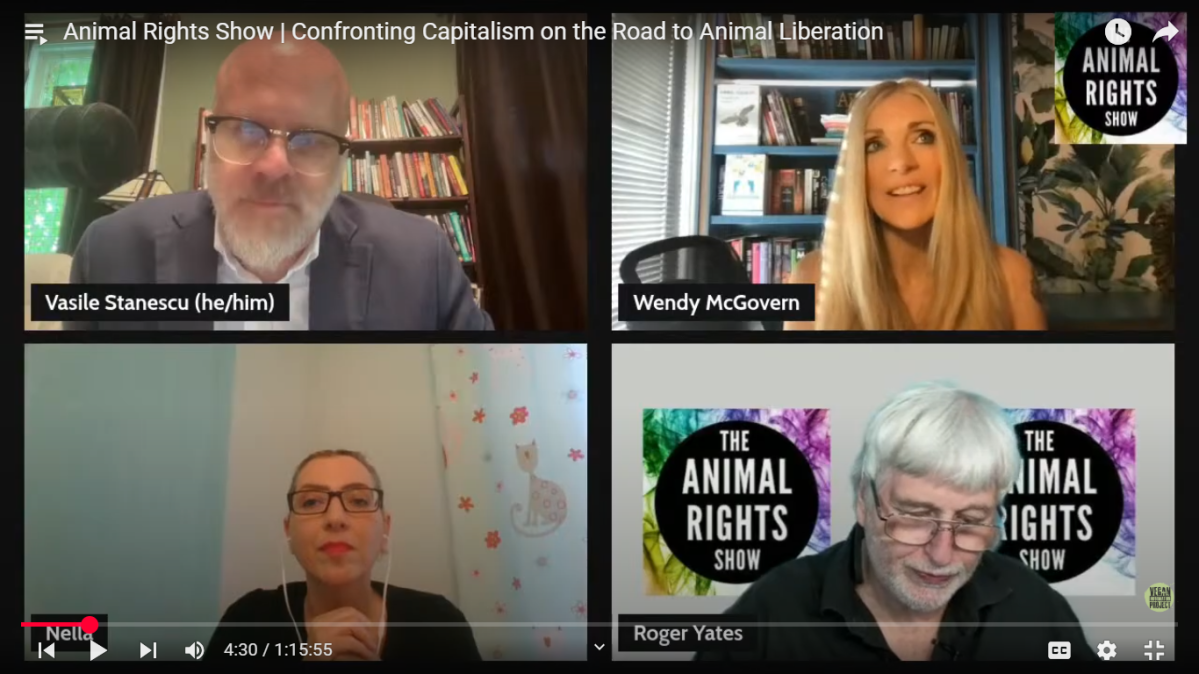
For some people it’s easier to listen and for some – read. For me – the latter is easier, especially then it is in English. So this time, I didn’t write anything myself, but just made and cleaned a transcription of The Animal Rights Show. The Animal Rights Show explores the theory, application, and current developments relating to veganism and rights-based animal rights as framed by Tom Regan and is lead by the legendary activist and sociologist Roger Yates together with fellow activists Wendy McGovern and Nella Giatrakou. This time they explored the need to confront capitalism and consumerism to make effective change for animal liberation, looking at how consumerist options (such as humane meat, lab grown meat, or impossible burgers) can never achieve social justice for fellow animals. This time the show had a guest, Vasile Stanescu who hared some insights from his work in the field of Critical Animal Studies, and his longterm advocacy for animal liberation.
This text is pretty long. And if you prefer to listen, then listen the show. Or listen Vasile’s podcast: How We Win: Achieving Animal LIberation in Our Lifetime. Just notice that I didn’t marked when Vasile is talking, or Roger, or Nella, or Wendy. Hope it’s ok. Enjoy!
Hey, Earthlings. It said on the screen that we’re live, so we must be live. So uh welcome everyone/—/ intros then? /—-/ Yes. So, as you can see, we have a very special guest panelist with us. Vasile Stanescu /—-/ Vasile: I am an associate professor of communication at Mercer University and all I do is work related to animals and the environment. So I have about 25 uh peer-reviewed publications and I work on issues like lab grown meat, humane meat, critiques of consumerism, the greenwashing by the animal agriculture industry. Yeah, that’s concise. /—-/
So, we have a very tiny topic to cover, capitalism. We’re hoping to sort it all out in one hour. So, no pressure there, Vasile. But just to start us off, a question that I have and actually this came out of a phrase that you use, which I love, by the way, from your podcast that you do with Devs, which is called How Do We Win Animal Liberation in our time? That is that correct? Is that the right title? Something you said was consumption should not be our liberatory strategy. And I thought that was just brilliant. Very concise way of saying it. But I just wonder because and as we were telling you before, one of our aims is to try to bridge the kind of academic scholar world with grassroots activism. And I just wonder when people out on the streets doing vegan outreach, how can vegans navigate that obstacle that you always come across when you’re having a conversation? Most conversations with non-vegans, they always come up with that obstacle of dietary challenges like, “Oh, I couldn’t give up my cheese or my meat and all that all that crap and stuff.” But how do activists navigate the fact usually you’re offering an alternative, a vegan friendly, animal-free product as a substitute for what they might already be consuming or whoever they might be consuming? But how do you navigate that without obviously feeding into consumerism? How what do you think we could do differently or better in our vegan outreach other than that? Thoughts about this?
Vasile: So the way I like to do it is a few things when I when I talk to people I like to start by asking what it is they care about. So whatever that issue is then I try to explain how that impact liberation. So with what they care about is workers rights and we start our conversation about how slaughterhouses are the most exploitive places. The workers exist with over 100% turnover rate every single year. When I first saw that statistic I didn’t think that was possible. There be over a 100% every single year. But of course there is if what they’re working on or they care about is immigration and of course right now in the US context we see a horror show around immigration and we talk about how slaughterhouse is ruthlessly bring undocumented workers in the United States exploit them and then actually call eyes on them when they start to unionize um and live in kind of these like company houses. So we actually start with what they care about in terms of social justice and then connect it to veganism. So the start of the conversation is about social justice and then veganism is the outgrowth of it as opposed to like, hey, why don’t you try vegan cheese? Because the argument I’m trying to get them to get is to see it as a natural outgrowth of what they already believe in. The other thing I like to do is I like to tell people, and I always mean it meaningfully, but I always say, “Hey, I can tell you are vegan.” And they’re like, “What do you mean?” Because they’re still eating meat at this time. And I’m like, “Right, you’re vegan because it’s not a diet. You’re a vegan who just hasn’t stopped eating meat yet, but you’re a person who genuinely cares about justice, actually cares about other people, wants to make a difference in the world. And so your veganism is already you. You just need to align your actions to match. So that’s the way I try to frame it. Starting from social justice and then adding their consumptive choices as an outgrowth of the social justice thing they already believe in.
Good answer. And then would you still offer the alternatives, the substitutes, the vegan cheeses, etc. into that? Because I suppose, you know, we all have we all have to eat and vegans have to eat.
Sure. I mean there of course there’s no problem in being like here’s the how-to like working through and actually that’s a huge barrier and actually I think we actually do not enough work literally helping people figure out how to do it day by day. So I teach this class in animal rights. I’ve taught it for over 15 years. Many of my students go vegan because they take the class. But what I’ve learned is that so one student he watched “Earthlings”. He got really moved in the class. He didn’t tell me he was going vegan. He just went vegan on his own. He was having like nightmares. He had no idea what he was doing. He was an 18-year-old student in college and he was eating, he told me later, literally baby carrots in icing. Uh cuz he figured out both of those are vegan trying to survive on this and only found out because I saw him in his class and he was like not looking well. And I was like, “Hey, what is going on?” And then he told me all of this. So yes, we need to help people understand how to do the thing that they’re doing. But at the same time we need to help them understand that that consumptive practice is not the goal or the point or the strategy. It is simply something we are doing because of this larger thing that we really believe in.
To build on that I going to ask you in certain vegan and even activist circles there is this belief that we can somehow use capitalism in our advantage and influence the system through our consumer’s choices and of course this is this belief is based on the idea that money equals power under capitalism and vegan money it’s vegan power and although I personally find it find this idea to very naive and disempowering especially because it fails to acknowledge the fact that usually those who seek the liberation of themselves and others are not those with the tons of money and it also implies that if you don’t have money or much money you don’t have enough power but many vegans feel that we should choose our battles and that the battle against capitalism will be a huge one and they believe that liberation is possible under capitalism. Many times as Wendy said, you’ve mentioned that consumption cannot be a liberatory strategy. Could you please explain why we cannot defeat speciesism under slaughterhouse capitalism and what is slaughterhouse capitalism?
Thank you for the question. That is such a great question. There’s so much in it. I want to start just with your first point which is uh my biggest annoyance and one of the reasons I like want to be on the podcast to like spread the message is this constant reframe that our power as vegans is because of our consumption. And I hear it over and over and over again. I mean, I just saw it the other day when it was like as vegans, we don’t realize that we have so much power as consumers. And it is actually such a disempowering idea from everything you’re talking about. That suggests that the only power I have is the amount of money I have. It suggests people with more money have more power. The other reframe I hear all the time is vote with your dollars, which I’m pretty sure is illegal. You’re doing two things wrong if you’re voting with your dollars. It It’s not your powers as activist. Is not your power is academics. It’s not your power as people just as consumers and it is a naive idea of how corporations or capitalism work. Corporations do not care about us. They do not actually try to make products to make consumers happy. They invent stuff and then they trick us to buy it. I mean, think of bottled water. They take water from the tap. They put it in plastic that leeches into the water that is toxic. They sell it at huge markups. No one was really asking for this. This is something they just made up and then try to invent ways to get us to buy. So thinking that we’re going to achieve animal liberation through consumerism is simply a failed strategy. But it is a failed strategy that just keeps happening. It seems to me that the mainstream animal rights community and animal welfare community seems to just go after one kind of consumerous product after another thinking this new product will finally win. It’s like that Charlie Brown episode like with the football where this time he’s going to get to pick hit the football but she always pulls it up. Well, this time we’re told that the uh consumerism that Tyson that Purdue is really going to work with us and this time lab grown meat is going to work when humane meat failed. But every single time we see the results, which is just continued failure. So what I’m trying to tell people is why don’t we try something new an actual social justice movement where we tell people hey what you need to do is not buy this instead of this but actually confront speciesism and anthropocentrism which is what we really believe in the first place. So thank you.
That is the point that I’m trying to communicate to people. Consumption is not the way to achieve animal liberation. Indeed. And another thing, you know, it’s picking up on the what you said about corporations quite often because they’re looking for markets and niches and, you know, kind of uh gaps in markets, this kind of stuff. Often they’ll come into it drive the actual, you know, vegan-owned uh company out of business and then of course if it all goes wrong, they just go whereas the vegan-owned company would have carried on because they’ve got a philosophical reason to be there, not just a profit one, right? So it can be quite dangerous in that sense. Yes. So I’ll just give you a few examples. So, if you know Nimon Ranch was created by Bill and Nicollet Nimon. It is the largest producer of so-called humane meat in the world. Now, of course, there’s all kinds of problems with Nimon Ranch. There’s all kinds of problems when they owned it. There’s all problems with Nicola Nimon, who wrote a whole book kind of greenwashing beef. But at least they were different than factory farms. And at least they were trying to fight against factory farms. They got forced out by shareholders who wanted to keep the same product and just make more money. Nimon Ranch is not owned by Bill and Nichollet Nimon anymore. Bill Nyman won’t even eat Nimon Ranch meat because of how the animals are now treated. And it got bought by Purdue, a factory farm, and is now a wholly owned brand of the factory farm. Here’s where it gets really bizarre, Roger. If you go to the
website though today of Nimon Ranch when it’s like hey why buy Nimon Ranch? One of the reasons on the website is to put factory farms out of business but obviously buying Nimon Ranch and giving more money to Purdue farms is never going to put Purdue out of business. Here is the takeaway. Kayos will sell anything to us including a critique of themselves. They don’t care. They just want to make money. So whether it’s humane meat or lab grow meat or plant-based meat, we think that these are options that are trying to fight them. They see them as niche marketing and they are perfectly happy to buy them, gut them and sell them back to us even with rhetoric that critiques themselves. And actually that ties in a little bit to another thing that you talk about on the podcast um and probably in your work generally is that um like Ros was saying small vegan companies often can’t compete with the bigger companies anyway so they end up going out of business. You see this all the time. And then the larger non-vegan companies that then produce vegan friendly products they often help the vegan friendly products of those larger companies often help to promote the non-vegan offerings of those companies the the vegan halo effect. So actually whether you know unless it is a very small vegan company that you’re supporting generally the vegan products of the bigger companies you’re actually ending up promoting and proliferating the consumption of our fellow animals and bodies etc. That’s exactly right. That is exactly right and the term you used is the term that we use in the research. So it’s called the vegan halo effect. And let me just give you a few examples. Uh so probably the most famous one is Doc Martens. Now, to be clear, I own a pair of vegan Doc Martens. So, I’m not trying to call anyone out who happens to own a pair of dating Doc Martens. We have to exist in this world. But here’s the actual backstory what happened. Doc Martens was seen as this huge punk cutting edge revolutionary brand in the ‘9s, and then their market share almost completely went away. And so then they created Vegan Doc Martins to brand themselves as edgy, as doing something different, as making a real change. and they got lots of positive press behind it. But here’s what really happened. They never have sold very many vegan Doc Martens. It’s less than 6% of the total sales. Overwhelmingly, what they sell are leather boots, but the hype around having vegan Doc Martens led them to radically increase their market share and their profitability, which tripled. So, they have vegan Doc Martens, not to sell vegan Doc Martens, but to sell leather. And they’re selling more leather than ever before because of their vegan Doc Martens. The Impossible Burger at Burger King, same thing. This is the third veggie burger that Burger King has had. So, it’s not exactly revolutionary. You can go back in the day and watch people from PETA praising Burger King when it got each of the earlier ones, saying, “This is the one. This is really going to change the game.” And then they just come up with a new one. They sell very little of the Impossible Burgers. So why do they have it? To make Burger King as a whole seem sustainable, to seem like it cares, to seem like it’s healthy. It’s the same reason fast food restaurants have salad. They sell almost no salad. Who in the world goes to a fast food restaurant to buy salad? Literally, the fast food restaurants will order in salad, keep it there, let it rot, and throw it away. Salad is less than 1% of the fast food sales. So why do they have the salad? to make the menu as a whole seem healthy and to suggest that you are blame if you are ordering the unhealthy food. Don’t sue us. We had healthy options. You just didn’t choose them. Well, Burger King doesn’t have a salad, but they have the Impossible Burger for the same reason. And it’s even better because it will sit there in the freezer instead of rotting. So, they’re not selling very many of them. But what it has achieved is not lower cells of the Whopper, but more meat cells while having the vegan option. So, we’re not helping anything when we go and praise Burger King for having the Impossible Whopper. All we’re doing is greenwashing, humane washing, vegan washing, this ruthless corporation that’s exploiting tons of animals and all of their workers. That is not animal liberation. That’s not anything we should believe in. And it’s something that’s a complete waste of time for vegans to be doing. And it’s a betrayal of like all of our most basic values. So, let’s stop it.
Good point. Do you know what it’s really? It’s really changed because when we always end up doing this with Vasile, don’t we go when I first came into the movement like vegans or actually I was an animal rights activist way before I was vegan but animal rights activist vegans wouldn’t have touched some of these companies like now I see and the most recent one I’m coming to mind is Nutella. Nutella I’ve got a new veganversion of Nutella about and everyone’s raving about it. Oh my god, Nutella. Amazing. Amazing. And all this stuff. And I I just remember years ago when there were these products around or just these companies, not even vegan products to be honest, just products maybe like uh some kind of orange juice that was owned by say Unilever. Like Mar sell skin whitening to women of color. You know, Unilever has this product where they sell skin. These arenot anything that any vegan should be praising. These are not good corporations. They do not do vegan in the world. They just exploit allanimals, including humans. Sorry. Go ahead, Wendy.
No, I’m just saying you would absolutely right. You wouldn’t have touched them with a barge pole. Like I remember doing lots of leafleting of boycott Proctor and Gamble and it was showing you all the products that Proctor and Gamble own because they’re testing on our fellow animals, so-called testing. And so you wouldn’t touch them even if it was like orange juice, which you could technically drink the orange juice, but you wouldn’t because you wouldn’t buy it because you wouldn’t give your money to that company. But that seems to have really shifted in the last I don’t know how many years, but now vegans really rave about these products by these companies, Procter and Gamble, Unilever, Nestle and all of that which like going back we wouldn’t have like touched them. Wouldn’t go near them, would we? No. Wouldn’t go near them. No, it’s very different now.
You often hear them say that this is some kind of win because now vegan products are a you know a bigger part of the market. So this is thought to be a win of some of some kind. Yeah. That we are sorry more visible right now in a way. Yeah. Here is how we should measure wins. How many animals are dying and what are the conditions they are dying in? And every single day the number just keeps getting higher. So who cares about the market share? I mean and they’ll play funny math. They’ll be like, “Hey, such a percentage increase, 500% increase because if you go to 1 to five, you’re still at 500%.” But the reality is the numbers are always marginal and they’re going down. There’s so many companies that have already brought in their plant-based alternative, got the free hype, including by vegans, and discontinued it. Hardies in the United States have already brought in the vegan alternative, had the hype, discontinued. KFC had chicken, you know, vegan chicken, so-called vegan chicken, had the hype, discontinued it. So companies bring in new food products all the time. is like when McDonald’s is like, “Hey, we’ll have breakfast all day.” That’s nothing new or revolutionary. And it doesn’t have anything to do with animal rights or animal solidarity. It depoliticizes the entire movement. And we’re not going to trick consumers into caring about a social justice issue. You know, the thing I like to say is I am tired of all the winning. All the time I’m told, “Oh, we’re winning here and we’re winning there.” But they’re not real wins. What would a real win look like is a sustained actual decrease in the number of animals who are killed and exploited. And we’ve been trying this consumer strategy now for my adult lifetime. And for 20 years, the number has just keep increasing. So, let’s try something new.
Yeah, I would agree with that. Certainly. If it involves a critique of veganism not being a diet too, which would be good. Yeah. In lie of one of my questions, there’s a couple in the chat already. So, before we lose them, so we’ve got this one here from Jeremy the Ape. Is Tom Regan’s work a common topic in your animal rights class? And if so, I wonder what the reception is from the students. I’m assuming most are not vegan. Is Regan dated?
Now, Regan has never dated. I change the readings that we do from the class every single time that I teach it. I’ve never taught the class with the exact same readings twice in a row for 15 years. I think it’s something I forced myself to do, you know, because and also I always want something new and different to read.. Regan connects with a certain group of students uh who go vegan and they tend to be these like very thoughtful philosophical ones. And I think they might stay vegan longer than the others. And I think it’s important to differentiate things that can get people to go vegan for a little while and things that can get people to really stay vegan. So you know, things about health or diet or weight, what the health or these sort of things, I think those can make people be vegan for a little while. I think something like Regan or philosopher can get people to stay vegan more long term. Yeah, I don’t think he’s ever dated. I think actually the animal rights movement needs to like catch up to him. I think it’s almost the opposite of dated. Well, what I’d definitely agree with that and um Reagan himself would really be pleased about what you said because he was always worried about the revolving door that we’ve spoken about on this show quite a lot that he was saying, you know, one person comes and one person goes, you know, we we’ve got to figure out how to retain them as well as recruit. So you, if you don’t mind me just unders, you are exactly right. So pretty high numbers are going vegetarian or vegan. They don’t tell us this in the media, but they play around the numbers to get these artificially low numbers. In reality, in the US context, it’s like nine to 10% of the population is vegetarian or vegan, about 4% of which is vegan, about nine uh 9 to 10% is vegetarian and vegan. Under 50, which is even a more important number, it’s like 12 and growing. So, these are good numbers. You know, one in 10 people in the United States are vegetarian or vegan. So, lots of people are going vegetarian, vegan. The problem is the recidivism rate. a huge number of people go vegetarian to vegan and they don’t stay. And so I absolutely agree with you as a movement our focus has to not just be on recruitment, recruitment, recruitment, burnout of the vegans and vegetarians that were here and we’re trying to recruit ever more. It’s kind of multilevel marketing view of vegetarians or vegan. We just got to get two more people and actually nurturing and caring for each other. Who else is going to do it? We live in a world that is hostile to us every day that gaslights us continuously. And we have pretty good data why people don’t stay vegetarian or vegan. And it’s not because there’s not enough healthy, delicious food. It’s because they feel alone. They feel isolated. They feel like they’re doing isn’t making a difference. And so they quit. And so if we can just love the vegans who are vegan now, it is one of the single best things we can do for animal liberation. And I believe that from the bottom of my heart. I agree. I’ve never been known to argue. Let’s give all the vegans little heart out there.
The second question comes from Dennis Neis. Dennis is involved with Sentient Rights Ireland, which is a political party probably the only one really who takes the word right seriously. Usually anything to do with sentience gets kind of like whittleled down to welfare. But not in this particular group. Question: is there any best template you would recommend for out uh on street outreach and information please to encourage people to embrace veganism.
Well yeah so in a way just a reframe of what I mentioned before which is persuasion is based on listening not only talking. And so asking questions, listening, seeing who they are and what they believe in. And what we know from communication theory is what people want is to be right, not correct. And so an identity is what they’re struggling with in terms of becoming vegan. Exactly what we were just talking about, this vegan stigma. In their heart, what they’re really scared of is if I go vegan, will I be stigmatized? Will people not want to hang out with me? Not want to invite me for dinner. Will I be weird? And so if we can help them understand that they are already vegan, that this is an outgrowth of what they already believe in, that they’re already right, they need to just now be correct, that is what the data suggests is probably the most likely to help them go vegan. Regardless of what they say, what’s really going on is a struggle around stigma and identity and possibly trauma. Lots and lots of kids actually go vegetarian very, very young and their parents tell them, “Hey, you have to eat meat. It won’t hurt the animals or you’ll die.” And so there’s this hidden trauma that’s happening. I went vegetarian when I was nine and I just stayed. But think about all the kids that go vegetarian when they’re nine and then eat meat later. So it’s not exactly like they don’t know. It’s a kind of knowing not knowing around like hidden repressed trauma. I mean, think about it. If aliens came to the planet, they would figure out right away the way animals are treated. I can get a hamburger. It’s a dollar. Somehow the company makes money. The reason they don’t know is because they’re choosing not to know. They know enough not to know because when they were very, very young, they knew. And then they were told they had to forget. And so they’ve just been pushing it down as hard as they can their whole life. In my class about animal rights, I spend so much of the class just listening, you know. And this is what I tell them. And you could try this on outreach, too. The last day of class, I tell them, I am so sorry. Things should not be this way. This is not your fault. You just showed up. You’re 18. You did not do this. And I am so so sorry. And what I want is not for you to become vegan. What I want is to be wrong. That is all I have ever wanted since I was 9 years old. For this not to be happening, for factory farms not to exist. But we cannot have what I want. So we have to do the second best thing, which is to change it. I bet there’s not a dry eye in your class, Villi, at the end of that. that have me blobbing. We bond. We bond. Yeah. Yeah. So true. I really relate to that. I went veggie really young as well and not and I know you talked about like a lot of kids do that even when their there’s no vegetarian parents or family and it was the same for me. It was just the whole thing was very traumatic. But I was lucky my mom did support me in that as well in in her in her way. I just it just kind of ties back in. I think this whole being in solidarity with each other as vegans ties in with the whole going back to how we confront capitalism because something you and Devs talk about on the podcast as well is how capitalism isn’t only just about consumption. It’s a mindset. It’s how it trains us to think as individuals. It’s very individualizing, atomizing. And um you were talking in words like it’s disempowering, it’s isolating, it makes us feel small and lonely, and it’s overwhelming and depressing because of this limited power. And it’s all on us. Like you just said to your students, um it’s not your fault. And actually, I think as vegans, we can we tend to I suppose in our cultures take it on ourselves like, “Oh my god, I need to do more. What can I do? It’s never enough.” And so I suppose I’m thinking of a question here in terms of could you say more about what’s the antidote to that? Is that more community collaboration solidarity local grassroots supporting loving each other supporting caring all of that stuff. You just hit it out of the park. That’s what I believe in. Solidarity and solidarity in two ways. Solidarity first in how we think of how we treat animals. So, not this like, oh, I’m a human and I need to help these poor animals, you know, and uh which I often still see articulated in flyers. Um, instead of, hey, we are all animals. We are in this together. Animals are actively resisting their captivity and slaughter all the time. I mean, every single day I can find a headline. There was just one that came out yesterday about a cow who escaped and made it to an island and is like living on the island. And of course, all the meters are applauding and thinking this is great. So, we’ll set that cognitive dissonance aside for the second, but the point is every day they’re fighting their own captivity and slaughter and we are in solidarity with them because we all have a stake in this together. And secondly, solidarity with each other. You know, that’s all we got each other. That’s what we have. And you’re not going to kill 90 billion animals by a single person, no matter how depraved. That is a bunch of people working together in concert all the time. And we’re not going to stop it as one vegan, no matter how pure. We’re only going to stop it as a bunch of vegans working together in solidarity. That’s what I believe in. you mentioned two things in your answer. One is of course solidarity and I’m thinking that there some of the problems of this movement are the savior complex that we suffer from and that idea that the movement is split in two and one side is the animals
Yes. I was talking about the savior complex that um impeded us from standing in solidarity with our fellow animals and um that huge split uh within the movement the animals only people and the um human rights animal rights people that seems to you know to drive us apart. So what do you think about that?
We the savior complex is itself specicist and anthropocentric. If we think we’re better than animals and saving them, um voice for the voiceless, for example, uh that kind of reframe we hear all the time. I mean, that’s profoundly specicist. Animals have a voice. That’s when we know they hurt because they tell us because it sounds like they hurt. I mean, if you’ve ever known an animal, if you if you’ve ever lived with an animal, you know that they speak. You know that we can communicate. Yes, there’s translational error. Yes, there’s issues, but it’s not somehow impossible. And so, we should actually be listening to what the animals want, which is never humane meat, which is never uh lab grown meat, which is never hybrid meat, which is always I want to be free. I want to be with my loved ones. I want to be with my children. And so take the marching orders from the animals and fight for what it is they clearly want. And don’t think that we are somehow more rational or smart. And here is this elaborate strategy that we’ve concocted that we’re going to impose on the animals and actually experiment on them as they have done for lab grown meat with bovine fetal bovine serum. You know, which no animal consented for and actually fight for what they clearly want and believe in as anyone should in a solidarity movement. The most oppressed should call the shots. And there’s not an animal on the planet that has articulated any of these concocted theories. What they want is freedom and that’s what we should be fighting for.They want to be left alone and they’d probably say um we don’t want to be petted either. Another form of animal use.
Now we’ve got another couple of questions um before we move on. I think one from Deb. What is the common thread you utilize to make them know they are prevegans? Is it talking about how they feel about other animals already? This is your students.
I see. Well, it’s students, but it’s everybody. I mean, you know, and I actually have this something I do which if someone does anything good, I say,”How vegan of you?” You know, like uh someone gives something to charity, someone helps someone out, uh someone does something thoughtful, I say, “How vegan of you?” Because remember, stigma around vegan is the number one thing causing people not to go vegan and the number one thing causing people not to stay vegan. And so my goal is to change the associations with vegan. And I don’t think vegan is a diet. It is a philosophy based on justice, not being narcissistic, putting other people’s interest equal to your own. So anytime somebody does any of that. Someone’s like, “My mother is bedbound and I havebeen taking care of her.” And I say, “How vegan of you?” That is vegan.
You mentioned vegan justice in the podcast. I’m not sure if it was you or or Dev that mentions vegan justice as an alternative term what this would entail then. That’s exactly right. That’s exactly right and that is from Devs and that’s from the climate justice movement where it’s like hey we can’t have these single issues. Right.
Right. So you can almost see a parallel that’s happened within climate change and environmentalism which used to be just very white dominated and just focus on climate change and we’re not going to worry about issues of race and we’re not going to worry about issues of gender and we’re not going to worry about issues of class and we’re not going to worry about issues of colonialism and we’re not going to work. And a new movement which is actual climate justice says actually we have to talk and think through all of these to make effective change both in how it affects these different communities and how we’re going to bring all these different communities together to make real change. And that is what we need in vegan justice where it’s not going to be single issue and we only talk about the animals in these very limited ways but we actually bring in all these other issues for a liberatory movement that helps all of us because we are in solidarity. We are all animals and we all suffer under speciesism. We may suffer differently. We may suffer different amounts, but it is a losing situation for every single animal. So, we can all come together to make a difference. I’m just putting these points up from Philip from New York.
There’s a really um a really easy question for you here. How do you define vegan?
How long have we got now? Again, this is a great one for you, Roger, too, because I know you talk about this, you know, all the time. Yeah, but just in a limited way for me, vegan and animal liberation are synonymous. And I think I even like or prefer the term abnormal liberation between the two. Some there’s all these different feelings around vegan. But no one seems to be confused when I say I believe in animal liberation. You know and so it’s a holistic movement of nonviolence against all animals including humans.
Yeah. Well that’s a nice concise one. I wasn’t I wasn’t expecting that. Carolyn says it think it would be great if vegans designed our own messaging instead of using data science. Now this is very close to my heart and we’re really we’re really lucky in Ireland because the national and international groups are not very strong here. So although we do have some of their literature and that means that all the donations fly over our heads back to wherever most of the groups in Ireland tend to make their own literature which is great. Now I will say this I have very close friends who work at PETA and they are profoundly good people and ethical people. So I do think we have to be you know careful in how we say it. I mean the top level messaging of what PETA does is just regularly horrible. As you may have seen PETA recently decide to thank Donald Trump. For doing all this great work for animals which is you know the personification of non-vegan you asked what is vegan I’ll tell you what the opposite of vegan is the opposite of veganism Trump the just in every way in every way you know like put together that is that so they’re thinking the exact antithesis of everything they believe in they’re destroying any kind of solidarity with any other social justice you know literally PETA all the time I want to say read the room guys read the room you know and you get this sort of weird blowback where I’ll be like, “Hey, this is just horrible what you did.” Just obviously horrible. I don’t know if you remember a few years back they did a television ad where they dressed up in full Cu Klux Clan regalia. I mean, I’m talking the hood the hat, you know, to protest dog breeding. Well, you know, I’m not a fan of dog breeding. I’m also not a fan of using the iconography of racial terror to try to make a social justice argument. And then what I’m told is, well, no one cares what we say anyways. It’s like no one’s listening to their animal our our conversations about animal liberation. It’s like well why are you doing it then? Why don’t you start doing something that would be effective or someone would care about? So I am deeply critical of the top level of PETA but mindful that many of my favourite people actually work at PETA, you know, because they need jobs and they’re trying to make it through the day and Ingrid Newkirk doesn’t listen to them either.
I just want to just to wind you up completely this evening. Just going to show you this. I don’t know if you’ve ever seen this or not, but um there is Hang on. I think I got to take this one out first before I can bring that one up. There is a Vegans for Trump group. In fact, there’s two. You can’t even say the word.
And like I mean like one of the things that I was one of the things I was flabbergasted about there was I mean obviously Wayne Shawn from DXE said that he thought that Trump would be really good for our fellow animals. And then there was a panel a British based panel I think it was and they were talking about how Trump would be great for animal welfare as though that even matters anyway. And um I mean I’ve noticed that they’ve gone pretty quiet now these people but it does tie into my other question which was about shock and awe which you’ve covered in your podcast. you know, this idea of flooding the zone and you were saying that, you know, obviously this is a Trump strategy just to kind of blow everybody’s mind, nobody can catch up and everything. And you claim that you thought in terms of shock and awe that vegans above everyone else in a way were perfectly suited to tackle this. and you said that they were uniquely practiced in dealing with shock and awe. So I wonder whether you could define those terms for us and talk about what you what you meant by that. Sure. So we have the receipts Steve Bannon, one of the chief strategists for Trump articulated before Trump was ever elected that the plan if they got elected was as you say to flood the zone to just do so much so quickly that nobody could keep up. that one outrage would just make the new outrage. That the news cycle can only focus on one thing at a time, like a toddler. And so the horrors that happened yesterday will be forgotten if the horrors the next day are even worse. And that is clearly the strategy that we have seen played out, which is constant executive orders, many of which are overturned, many of which are unconstitutional out of the gate, but just keep it going so that people get demoralized, overwhelmed, can’t focus, and they can get more evil through. So that is what has absolutely been occurring and what I said is look a lot of people on the left this is some sort of wakeup call because some people thought things were okay beforehand and suddenly they’re realizing that they are not. But we as vegans have known things are not okay for a very long time. And so we are used to living in a world of seeming impossible odds uh feeling hopeless of being told we can’t make a difference and working hard every single day. And so we uniquely are trained for this moment to be able to make an actual difference in the world. And the positive side is that in many ways I’ve been seeing the vegan message actually resonate with people like never before because if you think everything is okay fundamentally embracing animal liberation is very difficult because you have to give up the idea that everything is okay but if you’ve already come to realize wait things are atrociously bad like my students when like I am so sorry if you come to realize that things are atrociously bad then you can actually start to make real revolutionary change.
I love the line you said, “Welcome to our Tuesday.”
Since we are talking about the podcast, the tide how we win and achieving animal liberation in our lifetime. Do you really think that do you really believe that we have a chance to achieve animal liberation during our lifetimes? And if yes, how we are going to achieve that? Yes. In the face of the the climate emergency.
Exactly. Because there is no other option. I mean, so here’s the thing. So people sometimes believe like okay we’ve been exploiting animals for all this time and we’re still exploiting animals even some vegans even some people in the animal uh liberation community. What they don’t understand is that that is not how things are working. When I first started uh my research we slaughtered and killed 55 billion land animals. Now it’s 80 headed to 90 billion. It’s over a trillion in terms of oceans. And here’s what’s going on. I mean we’re talking about empty oceans. We’re talking about species that are never coming back, right? Once go extinct, extinct. In terms of climate change, which my area of research, we’re talking points of no return, feedback loops, right? Things are going to get climate change is real. We’re happening, but it’s going to get very, very bad very, very quick. So, we are out of time. I mean, we can’t talk about animal liberation in like 20, you know, 200 years from now. There won’t be any animals to be liberated. We have to do it now. And so we have to have a kind of real urgency and a real immediacy that isn’t just like, okay, we’re going to get around to it, but actually making the real change. We’re simply out of time. That is just the peer-reviewed truth. That is the reality. And so we have to make real changes right now. in our lifetime is the window.
Do you see people doing the right thing and the simplest thing and by going vegan and you know um completely changing ideologies, philosophies etc.or they are going to go for the for the easy solution and turn to lab meat for example which is not vegan as you as you said. Or you know delay the the solution even more.
Yeah, I am a huge critic of lab grown meat. And you know what people get mad at me about just keeps changing. But people including vegans stayed mad at me. So they were mad when I was critiquing humane meat. They would argue with me after my presentations, tell me that I was wrong, that I didn’t know what I was talking about. Uh that has happened less. Largely people are realizing that that is incorrect. Um, now what they’re mad at me about is when I tell them the difficulties with lab grown meat. But here is the main takeaway trying to say, okay, we have to actually have animal liberation. We’re called utopian. What they are talking about is actually utopian. Lab grown meat uses more fossil fuels, more energy than even factory farms. So it is utopian. It won’t work. It can never work. There is not a single peer-reviewed study ever that has said it is sustainable or scalable. So why are we wasting time on it? Time we don’t have. The good food institute was as a proponent hired not a peer-reviewed study. They hired a industry consultant that they paid to try to make a study saying it was sustainable. And the way they did that is they imagined 100% of the energy came from renewable energy solar panels. And they said if all of it just came from solar panels then it might be sustainable. But you can make anything sustainable. You can make a Hummer sustainable if you say, “Okay, all the energy inputs that go into making the Hummer come from solar panels.” That’s just playing around with the numbers. That’s not real data. So they use a rhetoric of being realistic. They say, “We’re realistic. We have to be realistic. You are utopian.” But what they are suggesting is in reality utopian, impossible, can never happen, non-existent. And what we’re talking about would actually work, is actually possible. If we go back to the level of meat consumption that happened in the 1950s, not a high point for animal liberation, that would bring a 75% reduction in global meat, which is what the UN says is necessary for economic for environmental sustainability. So why is going back to the level of meat consumption that happened in the 1950s, somehow utopian and creating cloning, cloning is somehow realistic and feasible. So stop with the nonsense. The options they are giving are not supported by peer-review data. They are not realistic. They are not scalable. They’re not sustainable. They can never actually happen or work. And they are a distraction from the work we actually need to do. And we are out of time to keep wasting the time on stuff that everybody knows can’t actually work.
Stop the nonsense. I love that. We should get a banner. Just stop the nonsense. Just tying this back into the topic of capitalism which obviously we have kind of been going out around and about and just wanted to bring it back to something I am going to mention this person Peter Singer when asked and I came across this in something that you wrote I think or the podcast that when he’s asked about capitalism like should we confront capitalism or something like that. He tends to have the response of we’ve got enough to think about in the vegan movement. Well, not that he’s actually vegan. In the animal rights movement, we’ve got enough to think about without having to consider capitalism. And I think the trouble that we have in the movement as well is I think a lot of vegans feel that way too that it’s actually overwhelming. It’s overwhelming to have to think about how like I’m in this system. It’s a huge juggernaut of a system. I don’t even I can’t even imagine what it would be like without capitalism, consumerism, etc. I’m already got this huge task of trying to get people to listen to what I’ve got to say on veganism and animal liberation. How the heck do I tie this in with such a massive topic of capitalism and all the other -isms that we, you know, obviously we don’t want to be single issue, but it feels huge and it can feel overwhelming in that way. But I just wonder if you’ve got any thoughts on how as advocates, activists, in our daily practices in our activism, how can we start to do that? How can we start to confront capitalism that isn’t in an overwhelming way? Is there is there anything that you can think of?
Yeah, you’re exactly right. So, Peter Singer, and actually Richard Twine, who was here earlier, who’s the first person I ever saw who asked this question. So, we were at an animal conference. Peter Singer was the keynote and Richard asked him what about capitalism and he said we have enough on our plates uh without dealing with capitalism and then I was at another talk where I was actually responded a critic of Peter Singer and that was actually about effective altruism and he was asked about capitalism again well maybe global poverty is produced by capitalism and the solution isn’t just individual acts of charity but actually dealing with the cause and he said well we have enough on our plates without dealing with capitalism so across the for he is someone who says we should set capitalism aside. We will somehow deal with all these problems without confronting capitalism and there are a few problems with that. You mentioned slaughterhouse capitalism earlier. The truth is that the factory farm the we hear the farm part we don’t always hear the factory that capitalism industrial capitalism fordism is actually an outgrowth of the assembly line. Ford in his own autobiography said he got the idea of the assembly line by studying uh the disassembly line of the Chicago slaughterhouse. Capital, the word capital is literally refers to the head of cattle. So the entire history of capitalism and animal exploitation have been interwoven and are co-constitive phenomenon and we’re never going to win one without confronting the other. It is the same plate. That is the point. It is the same plate. Owning, commodifying animals, including humans. And so, we’re only going to make a change if we confront what is actually going on. Now, you talk about being overwhelmed. I mean, I think doing one strategy that doesn’t work after another, which isn’t even what we really believe in, is far more overwhelming. That’s certainly the way that I feel. The last PA protest I went to, which was 20 years ago, uh the protest was we’re at KFC and we were told to uh argue KFC was killing chickens one way and we were supposed to argue we wanted them to kill chickens another way. And we were not allowed to tell people that they should go vegan. Everyone asked what kind of chicken they should be eating. So that felt demoralizing and overwhelming to me. I would have felt much better just saying what I really believe, you know. Uh, I keep telling people, and it seems so strange to say, say what you really believe. Stop trying to trick people. There is no evidence to suggest we’re going to get to true social justice by tricking people. Like, here’s this new trick that we’re It’s like a click. Like, here’s our new hack to make the whole world go vegan. Instead of saying vegan, say you’re vegetarian, even though you’re really vegan, even though we really think people should be vegan. Instead of saying vegetarian, say you’re plant-based. You know, even though there’s stuff marketed with called plant-based that I can go to the store today that has animal products in it because it’s not a meaningful regulated term. Instead of it could be a new slogan for our movement, honesty. Be honest to people. It it’s one of the fourth forms of rhetoric. I teach rhetoric, poss. But there’s another one which is just the power of truth. And people think I’m utopian when I say it, but if we want genuine change, look, there is a hunger for it. My students have it. They know this world is not doing well and they are hungry for real change, but they are not hungry for more. And so if we try to trick and lie to people, Tyson is always going to win. They’re just better at it and they have deeper pockets. The strength we have is to tell people what is genuinely going on. And that every single time I get to do it makes me feel better. Honesty is the key. I and I just wonder are people scared of being honest because of the whole thing we were talking about earlier this the stigma around veganism. It’s like oh I people hate vegans. We’re like the most hated people other than regular drug users. That’s right. Active users. That’s right. Active drug users. I better like pretend I’m not vegan and just like uh let’s go around the houses and pretend I’m not and let’s pretend that let’s just trick people into other things. Is that part? We get gas lit all the time and we do it to ourselves.Look, when I was vegetarian, I used to do this. I would hang out with people and they’d be like, “Oh, you’re vegetarian, blah, blah, blah.” I would say, “Well, you know, at least I’m not vegan.” And I would turn the conversation into like, “Hey, those terrible vegans.” And I didn’t believe it. I didn’t mean it. I feel bad about it now. Why did I do it? Cuz I wanted to fit in. You know, self-hating vegans is a real thing. But we don’t have to be that way. And we can do the opposite. And that’s what’s going to work. You know, I love being vegan. It is a joy. It is a gift. It is a blessing. It is not something I give up. It is not something I tolerate. It is the best part of my life. I love the food that I eat. I love the vegans that I know. I love that my son is vegan, that he is flourishing. I love that my partner is vegan. You know, it is my philosophy of everything that just also includes how I eat. And it is a joy and I’m so proud and grateful and I love being vegan. That is the opposite narrative. That narrative gets out. That’s when we start to get real change. Who wants to give up anything? That’ll be a good t-shirt.
Just to circle back a little bit, Vasile. You mentioned that Singer kept mentioning his plate. You know, our plate of full enough will I suppose his will include dairy cheese. But if we if we were to assume that he’s not actually true that Singer is part of the animal liberation movement is vegan or thereabouts or something should should we love him I mean you see that’s what I’m getting at in the sense that there are genuine differences you know between people who identify as vegans and you know you mentioned oh you’re plant-based you know it’s difficult it’s divisive to say you’re not vegan. But the truth is some people are not even though they call themselves that. So what do we do about them?
Yes. I have a few thoughts and it happens a lot with it happens a lot with lab grown meat. You know many of the proponents of lab grow meat really even are vegan you know in the full sense of that term. And so what I believe strongly in is calling people in, which is still a calling, and saying these actions you are engaged in are not vegan. Remember, I believe in telling meat eaters they’re vegan. Their actions just don’t align with who they really are. And many of Peter Singer’s actions do not align with true vegan ethics. All the ones you mentioned, but also the things he says about disability and it’s unconscionable eugenics, you know. So yes, you are still vegan. Absolutely.
Now your actions need to align with who you are. If we tell people they’re not vegan, they’ll believe us and they’ll stop. And if we say you are vegan, absolutely. Now have your actions align with what that means. That doesn’t change their identity. It calls them in and it suggests change is possible and change is always possible. My son was born vegan, but almost all of us used to eat meat and now we don’t. So, we can change our actions and so can they. And what I will also say is that we need to get out of this idea of these leaders and somehow we can’t call them in. Leader should be a verb, not a noun. Like a school of fish. A school of fish has someone in the front, but it could be anyone else.
Well, your answer is very challenging to me. I’ve got to admit, I mean, just this very day, Gary Yourofsky, announced that he’ll be joining AV for six weeks, uh, soon. And, um, it’s very difficult for me to stand alongside someone who has these kind of violent rape fantasies and stuff that that he does. And so, calling Yourofsky in, I would find that challenging, but I understand the point. And maybe it’s for me to figure out a way of doing it. No. And there are limits. Someone who poses clear intimate danger to others. Of course, you know, they need to stay away. But someone who is arguing for lab grown meat, which is not vegan, that person, I believe, even though I completely disagree with them, even though what I think they’re doing actively harms animals and actually harms the movement, I still believe my goal anytime I interact with them is to call them in and say, “Hey, we need you and what you’re doing is wrong. That strategy is wrong. that is not vegan. But you are still vegan and you can make your actions line with who you are at any time. And now would be a great one. We need you back to do a calling in workshop. That’s I I have a question. You don’t surprisingly you’re not on your own. Go ahead. Have you got another one? Yeah. I just this this kind of pops into my head all the time when this topic comes up. If not capitalism, what else what replaces it? And what does that look like? And also, I just wonder if you think there might be any positive elements in within the capitalist system that actually are helpful as in it’s not just a blanket, everything’s bad and we just got to get rid of all of it. How do we even do that anyway? But yeah, what what does it look like and what are those positive elements if there are any?
Sure. Absolutely. Yeah, what’s great about capitalism is all the cooperation. So, we’re told all the time that capitalism is competition, but that’s not how anything works. And you can see how it always causes oligarchy, which is one of the inherent contradictions of capitalism, why it always collapses. Because why capitalism works is the cooperation. Now, under capitalism, the cooperation is always forced. But think of an assembly line. I mean so many people are actually working together or when you buy that product made in China shipped over here brought to you by Amazon delivered on your front porch the number of people who all had to work together to make that happen was massive so in our capitalism you have kind of a funhouse mirror of solidarity of people working together but they’re working together because the other option is like starvation and fear and so what beats that is just more cooperation without the starvation and without the fear. And uh I have this term I like animal realism which is what we’ve talked about how people can’t even imagine even vegans can’t even imagine the end of animal exploitation even though the factory farm system has only been around since the 1920s and large portions of the world don’t even have it. And it’s based on this earlier term called capitalist realism which is capitalism hasn’t been around that long and large portions of the world aren’t even capitalistic but somehow we have trouble even imagining a world without capitalism but it is completely possible and alongside the capitalism we have to fight speciesism because the even non-capitalist um parts of the world are still speciesist so I guess that’s runs side by side would you say it’s all it’s all connected. Yeah. It’s all one plate. It’s not two different systems of ethics. We No animal, including humans, should be owned or bought or sold or soon as a resource, human resources. But here here’s the thing. What helps people to go vegan, part of the things that cause my students to go vegan, what help people stay vegan is seeing the buyin for them. And there’s nothing wrong with that. So Carol Adams is one of my mentors and one of the things she does so well is helping people see how the daily sexism they experience is related to speciesism. Well, helping people see the daily exploitation they experience under capitalism is actually related to speciesism is a buying. And it’s a buying when they realize, wait, I’m fighting for myself even when I’m fighting for animal liberation. Because these technologies, these systems of oppression that oppress all of us, that happens all the time and we can come together to fight against it. I think we can focus on what we focus on, but realize it’s part of a larger struggle, you know, and so I’m going to keep focusing on animal liberation, but I’m going to keep articulating it in ways that also deal with other issues. Anti-blackness, anti-trans sentiment, all these different other social justice issues. So, I’m going to keep fighting for what I believe in, and I believe in all of it, but I’m going to keep articulating it not in terms of single issue, just animals, not in terms of saviorism, but it’s solidarity with all these other social issues, and keep explaining to people how it’s all one plate. That’s how we get increasing buy in and that’s how we stop being the quote unquote ugly stepchild of the left and have people realize that we all have it together. The current way that we talk about it, be rich, be a consumer, that’s how you’re going to make change. Who on the left is going to buy into that movement. Every single time we do that, we’re saying, “Hey, anyone who actually agrees with really what we agree with, we’re not on the same side.” And if we start saying, “No, look, capitalism is terrible. Here’s a flyer on the street saying the way to fight against capitalism, the anti-fascist diet is a vegan diet. That’s a totally different way to think about veganism. And that’s going to make a difference for people on the left who already agree with these ideas. And instead of wearing one of the phrases, you know, go ahead.
One of the phrases you said that the podcast and stuck with me is that if oppressions are linked then solutions are are linked too. So would you say that this is your solution for anyone that fights for any kind of liberation um to focus on their specific struggle but also frame it in a way that highlights the connection with other oppressions and you know try to make people aware of how things work and that they are not you know in each oppression in their small box but everything linked to linked together and aim for solutions that are solutions that are universal that are for everyone for all sentient beings human non-human um for anyone who experience oppression.
The example that my spouse loves to give is how the Black Panthers helped out the fight for disability rights, you know. So, you can still believe what you believe in and you can still help and fight for other social justice issues. And the thing is, if you’re in those spaces really fighting for those other social justice issues, it’s going to change how they see vegans and veganism. and you can just talk to them and be like, “Look, this is why I do it and I do it as part of what we both believe in. That is part of why I’m doing this.” Stop. I love that. But see, do you think and I know this is your area of research as well.
Do you think the climate crisis, climate change is going to in some in many ways force the issue anyway? Because there’s that, you know, like you were saying, the loops and it’s escalate thing.
You know, we’re already seeing fires and freezing and floods and so much more of these catastrophic events so much more regularly and things like this and so many more things that you don’t even think about. I read a book called “The Uninhabitable Earth”. I don’t know if you are aware of that one. And just some of the things that the writer talked about and a lot of science that they brought together in that book was things that you don’t even think about to do with climate change things you wouldn’t even imagine and you think how is that related but it’s just like a such a knock-on effect but I just wonder is this going to force the issue in terms of how we live what we do the resources we have the land we have like we’re talking about so-called animal agriculture a lot of land is needed for that is this going to change do you think because of what’s happening?
It’s a complicated question. So part of the answer is yes. There is a movement that is happening right now real movement among environmentalist towards real change around animal agriculture which is massive which is real which is well funded. It is the second leading cause of emissions after petroleum industry if you include the possibility of how the land can be used. So we get all this land back and say you planted trees and the sequestering of carbon that would occur by the trees being planted, it could move to the number one. So it’s the second leading cause of emissions. And if you actually have the leading cause of like solution, you see what I’m saying? Not just decreasing emissions but actually helping methane which is produced by the cows burp more than flatulence actually but you know is stays in the atmosphere for a shorter period of time and so it is the leading way to buy some time to make big structural changes if we’re able to radically decrease the amount of methane it would uh help slow the warming and it would give us time to do bigger structural issues so you have very serious very clear-minded environmentalists who are calling for reduction of meat consumption regularly, constantly in peer-reviewed publications across the board. And at the same time, maybe because what you also see is mass greenwashing by these companies like Tyson to try to trick people and that they’re making a real difference when they aren’t by like, oh, feeding them algae or uh using brown coal or all these sorts of nonsense ideas, giving them steroids. And so that’s why yes, but yes, but we still have to push and have the social justice aspect. It is an opportunity, but we have to push so that the same bad actors don’t seize upon the movement, trick people as they have tried to do so many times before. Yes, but another good t-shirt slogan, right?
Well, thank you so much for being our guest panelist. So, this is, the podcast that we’ve all kind of really been making references to, and it’s pretty easy to navigate. So, that is, where to go, folks. And, it’s got a great line to start with as well. Veganism is not a diet. It’s distressing, isn’t it, for all of us, I’m sure, the number of people who still believe that and will say it out loud. And you know it’s just amazing to me that they would reduce veganism just to a diet that um I think I think the normalization of all those products though that doesn’t help in a way in that or that proliferation and the fact that we talk about these products and rave about the new vegan product coming out of this brand. I think that feeds into it so much because it’s just it’s normalizing the dietary aspect of veganism as ifthat’s the only thing because although there are many more people aware of veganism now, they’re only aware of the dietary side of veganism. That’s what they think vegan is. Yes. And just to uh make sure people know it’s win foranimals.org or that podcast if you want to chase it up and do some more research and it’s very well worth it. Right. Well, uh just make sure I’ve got all my buttons ready. So, uh I want to thank everybody for staying with us. It’s been a great show and um we shall be back again soon. Not next week, but soon. And um thanks again for everybody who took part and uh we’ll see you again.
Could I say one last before everyone goes? Is it okay? Yeah, go ahead. I just want to end with a thank you for all of you. As I mentioned earlier, we know that the number one reason people don’t stay vegan is that they don’t feel appreciated. So, I just want to thank you from the bottom of my heart. What you’re doing is the most important thing in the world. And we are making a difference. There are more vegans and vegetarians than ever before. And each day we’re going to keep fighting, supporting one another, helping each other, and building a movement together until we win. And we are going to win. Thank you. I feel I feel all loved now. I feel all loved. I love that. Back at you. Back at you as well. Absolutely. Absolutely. So until next time, folks.
Yeah. Thanks everyone.
 more-than-human
You must be logged in to post a comment.